
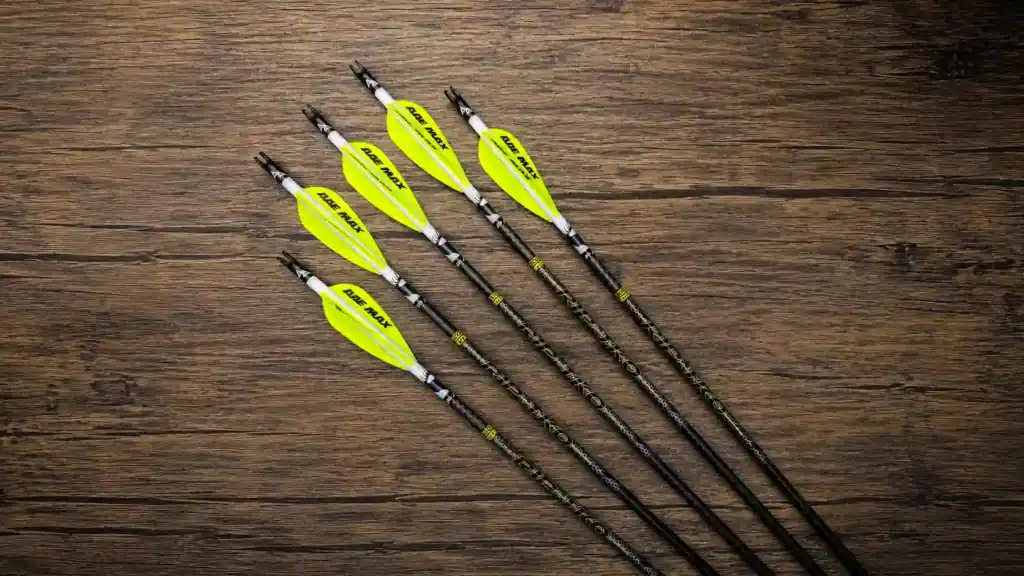
Pick up any two arrows off a shop wall, and they can look nearly identical: same length, similar price, comparable branding. Shoot them both from the same bow, and the results can be nothing alike.
According to World Archery, the sport’s international governing body, bows and arrows at every level of competition are matched to the individual archer’s size and strength, with spine requirements scaling directly to how powerful the bow actually is. Arrow choice was never meant to be generic, and getting it right starts with understanding your own setup, not comparing spec sheets in isolation.
That’s the gap most buying advice skips. Archers want tighter groups, but most arrow content hands them a spec sheet instead of a way to think through their own setup.
This is a decision framework, not another glossary of arrow specs, so if you want the full breakdown of what spine, diameter, and weight actually mean, our complete guide to carbon arrows covers that ground. Here, we’re solving a different problem: how to choose the right arrows for your specific bow, goal, and shooting conditions.
The Real Starting Point Most Archers Skip
Most arrow searches start with specs. That’s backward. The better starting point is your intended outcome, because the answer to “what’s the best arrow” changes completely depending on what you’re trying to accomplish.
A hunter chasing deep penetration on a quartering shot, a target archer chasing tight groups at 50 meters, and a weekend shooter building consistent form all have legitimate, different definitions of “best.” Specs only become useful once you know which of those goals you’re actually solving for.
How Your Bow Setup Quietly Limits Your Arrow Choices
Your bow narrows the field before you ever compare a single arrow model. Draw weight determines how much energy is available to transfer into the shaft. Draw length changes effective arrow length and, with it, spine requirements.
A bow’s speed rating interacts with arrow weight to determine kinetic energy and trajectory. Release style, finger release versus mechanical, changes how the arrow reacts as it leaves the string.
Arrows fail more often because they’re mismatched to one of these variables than because they’re poorly made. A perfectly good arrow on the wrong bow setup will almost always underperform, regardless of build quality.
Why Spine Is the Hidden Driver of Accuracy
Spine describes how much an arrow flexes when the bow’s energy transfers into it, and it’s arguably the single biggest determinant of accuracy in the entire buying decision. An arrow that’s too stiff or too weak for your setup won’t recover cleanly from that flex, no matter how good the rest of the build is.
Spine charts get misread more often than any other spec, usually because archers change spine to solve a weight problem instead of adjusting inserts or points. Our spine consistency breakdown explains static versus dynamic spine in depth, including how our own dozens are digitally spine-aligned before they ship, if you want to go deeper on the mechanics.
For this decision, the practical rule holds: match spine to your actual draw weight, draw length, and point weight, not to what a friend shoots or what looks stiff enough on the shelf.
Diameter Selection Is About Conditions, Not Preference
Micro-diameter shafts generally cut through wind more efficiently and, for hunters, drive deeper penetration by concentrating force over less surface area. Standard diameter shafts trade some of that efficiency for a wider margin of forgiveness and easier fletching and component work.
Smaller isn’t automatically better. A hunter shooting in consistently high wind or targeting deep penetration on tough game has a real case for a micro-diameter build like the VAP™ TKO.
A target archer shooting indoor 18-meter rounds may find a standard diameter shaft cuts scoring lines more favorably. The right choice depends on where and how you’re actually shooting, not which diameter sounds more advanced.
Weight Changes How the Arrow Behaves More Than People Expect
Lighter arrows fly faster and flatten trajectory, which helps at unknown or extended distances. Heavier arrows sacrifice some speed but carry more forward momentum and are generally more forgiving of minor execution errors. Neither is universally correct; both are trade-offs that should be picked deliberately rather than defaulted into.
Weight also affects energy transfer on impact for hunters and stability in flight for target archers. This is also where dozen-to-dozen weight matching earns its keep: a weight decision only holds up in practice if every arrow in the set actually weighs what the spec sheet claims.
The honest answer is that your goal decides which side of the speed-versus-momentum trade-off matters more to you, not a generic recommendation.
Build Quality Determines Whether Arrows Group or Scatter
Two arrows with identical spine and diameter specs on paper can still perform very differently if they weren’t built to the same tolerances. Straightness variation means each shaft flies a slightly different path. Weight variation between arrows in a set means each one carries slightly different energy downrange. Component alignment, particularly at the insert, affects front-of-center balance and how consistently the arrow flexes shot to shot.
This is why manufacturing tolerance matters in practice, not just on a spec sheet, and why a properly bonded insert isn’t a minor detail. Our Black Fusion insert adhesive exists specifically because a bond that loosens or shifts over time reintroduces the exact inconsistency that tight straightness and weight tolerances were built to eliminate.
Why Your Use Case Should Change Your Arrow Decision
Hunting setups should prioritize penetration, durability, and reliability under field conditions that a range never fully replicates. Target setups should prioritize repeatability and tight grouping over raw speed. Practice arrows can reasonably trade some performance for cost, provided they still hold consistent enough spine and weight to build real technique rather than compensating for equipment.
Youth and lower draw weight archers deserve their own consideration here too, since a spine and weight range that works for an adult setup usually won’t for a developing archer. If that’s the setup you’re choosing, our coach’s guide to selecting youth carbon arrows walks you through it safely.
When the Problem Isn’t the Arrow at All
Sometimes the arrow was never the issue. Poor bow tuning, inconsistent form, or an off-center rest can all produce the same symptom as a bad arrow choice: inconsistent groups.
Before buying your way into a new setup, rule out whether the real problem is a tuning issue, since it’s the more common culprit for shooters at every skill level, and re-verify spine and weight against your actual setup before assuming the arrow itself needs to change.
A Smarter Way to Choose Arrows Without Guessing
Start with your bow’s actual specs, draw weight, draw length, and typical point weight, rather than a model you like the look of. Match spine to those numbers using a chart or calculator built for your setup, since spine mismatch is the root cause tuning adjustments are least equipped to fix.
Choose diameter based on your real shooting conditions, wind exposure, and penetration needs for hunters, indoor scoring lines for target archers, rather than defaulting to whichever diameter is most heavily marketed. Adjust weight based on your actual goal, speed and flat trajectory versus momentum and forgiveness, and treat it as a deliberate trade-off rather than an afterthought.
Prioritize consistency, straightness, and weight-matching held to a real tolerance rather than a marketing claim, over price whenever the two are in tension, because an inconsistent arrow adds a variable your practice time was never meant to solve.
Which Arrows Deliver the Best Balance of Accuracy and Performance
Once your bow specs, spine, diameter, and weight goals are locked in, the remaining question is construction quality. Arrows built with digital spine alignment and dozen-to-dozen weight matching remove the guesswork from everything above, because the numbers on the label actually hold up shot to shot.
The VAP TKO reflects that standard, built for hunters who need the arrow to perform identically to the last one in the quiver, not just the first one out of the package.
Why the Right Arrow Feels Easier to Shoot
An arrow properly matched to your setup doesn’t announce itself. Groups tighten without extra effort, tuning frustration drops, and the confidence that comes from predictable flight compounds over every session. That difference is felt more than it’s measured, but it’s the actual outcome the framework above, and the spine-aligned, weight-matched dozens behind it, are built to produce.
Why Victory Archery Builds Every Arrow to This Standard
Victory Archery’s engineering team brings an aerospace and composite materials background to every shaft built at our Carlsbad, California facility. That background is why the framework above isn’t just theory here: every arrow line, from youth shafts to Elite-grade target arrows, is digitally spine-aligned and weight-matched within a dozen to plus or minus 0.5 grains, well inside the industry-standard tolerance of plus or minus 1 grain or looser.
In practice, that gap matters more than it sounds: an arrow that’s two grains heavier than its neighbors will hit differently at distance no matter how well everything else is tuned, and it simply doesn’t make it into one of our dozens.
Straightness tolerances run as tight as plus or minus .001 inch on our Elite-grade lines, the difference between a shaft that behaves identically to the eleven others in the case and one that quietly introduces its own variable every time you nock it.
Ready to Build a Setup That Actually Matches You?
The right arrow isn’t the most popular or the most expensive; it’s the one that matches your bow, your goal, and the conditions you actually shoot in.
Find a Victory Archery dealer near you and get matched to the setup built for how you actually shoot.